Tuesday, 4 May 2021

A High Performance RF Mixer For The G6LBQ Irwell HF Transceiver

HF Transceiver H-Mode Mixer Module

In this blog post, I present details of  my high performance H-Mode RF Mixer stage. The H-Mode RF Mixer is a high performance circuit and a module for my homebrew ham radio transceiver that I call the "Irwell".

The H-Mode mixer was designed by Colin Horrabin G3SBI with subsequent revisions published by Giancarlo Moda I7SWX and Martein Bakker PA3AKE. Full credit is acknowledged to Colin, Giancarlo & Martein for their extensive work and research on the H-Mode mixer.

The H-Mode mixer gets its name from the letter "H" depicted in the transformer configuration, which resembles an "H".


During my research of the H-Mode mixer, I came across an interesting article by Bob Burns G3OOU, who used three individual NC7SZ04 TinyLogic high-speed inverters in the squarer, noting that the devices improved the VHF response and reduced power consumption above 50MHz

Wednesday, 14 April 2021

Cascode IF Amplifier With AGC For The G6LBQ Irwell HF Transceiver


HF Transceiver IF Amplifier Module

"Cascode IF Amplifier & AGC for the G6LBQ Irwell HF Transceiver Project"

In this blog post, I present details of  my Cascode IF amplifier with AGC function. The IF amplifier constitutes as a practical module for my HF multi-mode radio transceiver, which I call the "Irwell HF Transceiver".

My version of the Cascode IF amplifier is based on Wes Hayward's (W7ZOI) & Jeff Damm's (WA7MLH) as presented in QST magazine December 2007.

Sunday, 21 March 2021

Multimode Audio Sub-System For The G6LBQ Irwell HF Transceiver


HF Transceiver Audio Amplifier Module

"A Multi-mode Audio Subsystem for the G6LBQ Irwell HF Transceiver Project"

G6LBQ Electronic Project Banner

As I mentioned in my previous blog post, I have been developing a high-performance HF multi-mode radio transceiver based on a series of modules that can be upgraded or improved over time.

For this blog post, I present my multi-mode audio amplifier subsystem, which handles the receive audio for the various modes of operation.

Sunday, 7 March 2021

Noise Reduction for radio communications.

 DSP Audio Noise Reduction

"Noise Reduction for the G6LBQ Irwell HF Transceiver"

For some time now, I have been developing a high-performance HF multi-mode radio transceiver based on a series of modules that can be upgraded or improved over time. 

The modular approach has some great advantages and makes it easy to upgrade the transceiver or carry out repairs. There is, however, a negative effect of adopting this approach in that I find myself constantly changing things and wanting to try different ideas and ways of doing things.

Suffice to say my "Irwell HF Transceiver project" is very much a labour of love and a long-term project that is often sidelined while I moonlight on other projects.

I am for ever the optimist that my "Irwell HF Transceiver" will one day be finished so I will continue to add new additions and make improvements!

Tuesday, 9 February 2021

Allstar Link Node Build - Part 6

Welcome to part 6 of my Allstar Link node build. 

In this instalment the project finally comes together with the boxing up of all the various modules and parts that I covered in my previous blog posts.
 

Choice of enclosure

To enclose the project, I decided that I wanted to keep everything screened to minimize the possibility of unwanted interference in the shack. You may remember in part 4 of my build I commented that there's a reason computers are built into metal boxes!

I suspect that some readers of the blog maybe thinking but "my laptop case is plastic";  therefore my comment or argument is not a valid one! 
 
Well, having stripped down many laptops for repair, I can substantiate my point due to the fact that the internal electronics of a laptop are shielded either by tin sheeting or a screened coating on the inside of the plastic shell, the same can also be said for tablet computers and mobile phones.

Friday, 29 January 2021

Allstar Link Node Build - Part 5

Welcome to part 5 of my Allstar Link node build. 

If you read part four of my node build, you probably arrived here expecting to read a blog post covering the grand boxing up of the project!  Fear not, this is just a short interlude and the boxing up will now commence in part 6.

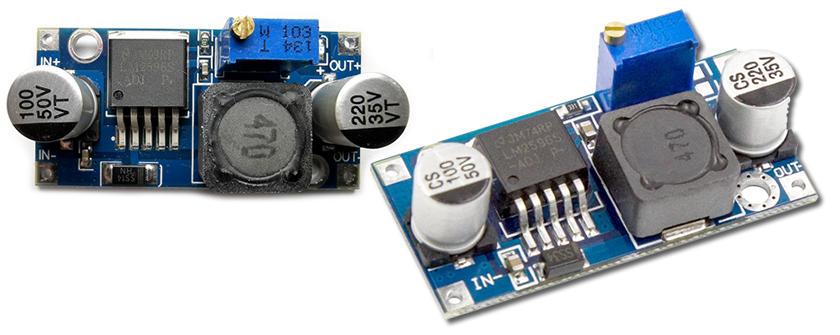
I need to vent a little about my concerns regarding the "Buck Converter Module" that is commonly used in node builds. The idea of using a buck converter to regulate a DC supply voltage is fine and I intend doing this myself but there is a caveat! 

If you are not aware of what a buck converter is, it is a type of switch mode Power Supply; they are highly efficient when compared to traditional linear voltage regulators.

The buck converter module that I will be referrincing is shown below and can be purchased from eBay, AliExpress and many other online sources for less than £2. 

Allstar Link Node Build
These modules are sold as being equipped with a LM2596 switching regulator,  a device from the Texas Instruments portfolio of power management devices.

Tuesday, 19 January 2021

Allstar Link Node Build - Part 4


Welcome to part 4 of my Allstar Link node build. 

In this installment I will prepare some additional components in preparation for casing the project up.

Before I get started

In the last installment, I covered modifying the popular CM108 USB sound module for use with the Allstar Link Node and I remembered that I had used the CM108 in a digital mode interface that I designed and built back in 2018.  Below is a photo of the interface completed.

G6LBQ Digital Mode Interface
Click for a larger image

Sunday, 10 January 2021

Allstar Link Node Build - Part 3


Welcome to part 3 of my Allstar Link node build. 

In this instalment I will start working on the CM108 USB sound modules and show you how to modify one for use with an Allstar Link node.  The module forms a link between the modified Baofeng radio transceiver and the Raspberry PI single board computer.

The CMedia CM108 is a highly popular single chip USB audio solution. All essential modules are embedded into an LQFP 48 pin package. The chip includes a dual DAC, earphone driver, ADC, microphone booster, PLL, voltage regulator and USB 2.0 compliant transceiver.

Cmedia CM108 IC
Shown enlarged, the actual IC is 7mm by 7mm 


Saturday, 2 January 2021

Allstar Link Node Build - Part 2


Welcome to part 2 of my Allstar Link project build. Before I continue, I would like to take the opportunity to wish everyone around the world a happy, healthy and prosperous 2021.

Friday, 1 January 2021

Allstar Link Node Build - Part 1

The Digital Age and the Internet of Things

"Plus A Ham Radio Project for the Digital Age"

G6LBQ Micro Node

As I wrote this blog post near the end of 2020, I cannot help but marvel with admiration at the technological achievements that have been made since I ventured into the world of radio and electronics back in the 1970's.
 
I have witnessed the development and progression of electronic devices, such as transistors, integrated circuits and optical devices, such as LEDs and LCD displays.  These electronic wonders helped develop electronic and analogue equipment, such as photocopiers, printers, fax machines, modems, computers and mobile phones, all of which are now part of everyday life.

Saturday, 28 November 2020

A Trip Down Memory Lane Pt3

I return with more memories detailing moments and events that were prominent in my evolving journey into the world of radio and electronics.

In part two of my "trip down memory lane" and during 1979 I detailed my discovery of Citizen Band Radio, this introduced me to the world of two way radio communications and brought about a deep fascination in transmitting with a craving to build a transmitter myself.

Friday, 6 May 2016

A Trip Down Memory Lane Pt2


By 1978 I was 14 years of age and in my third year at senior school, I also had my foot on the working ladder, having become gainfully employed on a local farm working part-time.

Working put money in my pocket and burned the proverbial hole in it, as I was always eager to spend it!  My interest in radio and electronics flourished and I was able to buy hobby magazines like Everyday Electronics, Practical Wireless and Shortwave magazines.